
The ongoing discussion on local budgets has largely focused on the share of personal income tax (PIT) revenue that should remain in hromadas. However, reforming this tax also involves another important question: what principle should be used to allocate PIT revenue among hromada budgets?
Polaris Programme expert Ihor Herasymchuk took part in a roundtable organised by the All-Ukrainian Association of Hromadas to discuss possible models for allocating PIT revenue.
Currently, PIT is largely paid based on the employer’s registered location, even though an employee may live and use public services in another hromada. Ihor Herasymchuk presented the experts’ position and analysis on a possible transition to allocating PIT revenue based on the taxpayer’s registered place of residence.
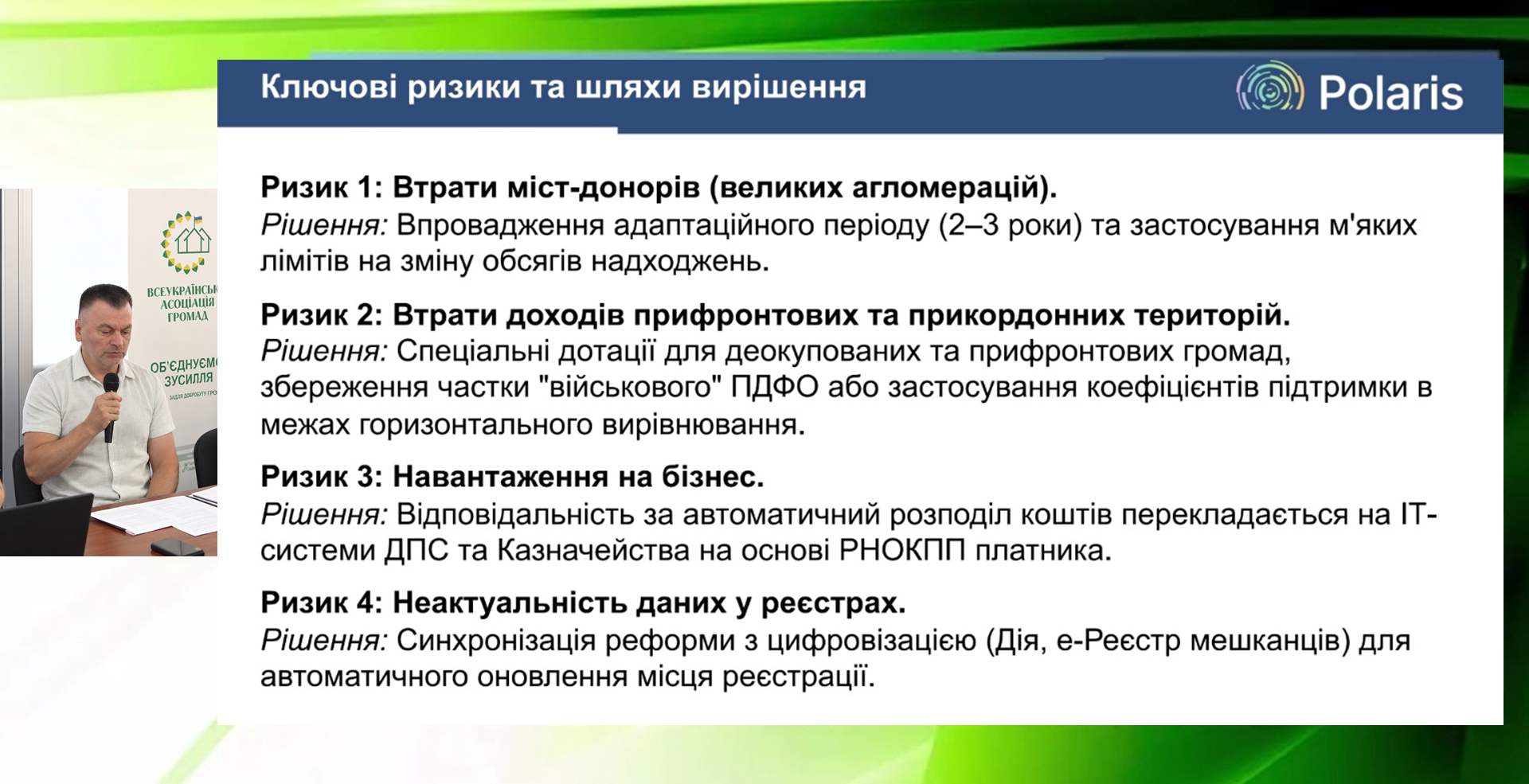
“Changing the principle for allocating personal income tax revenue should not be reduced to a mechanical redistribution of funds among hromadas. The reform must be predictable, avoid placing an additional burden on businesses, and take into account the situation of hromadas that may lose part of their revenues,” said Ihor Herasymchuk, an expert of the Polaris Programme.
The expert also highlighted that under the current model, around a quarter of PIT revenue is not allocated to the hromadas where taxpayers actually reside. Changing the system could remove a significant proportion of rural hromadas from the category of subsidy-dependent hromadas: “Twenty-five per cent of PIT revenue is allocated outside the taxpayers’ actual place of residence. The share of subsidy-dependent hromadas would decrease from 70% to 50%.”
The parliamentary context of the discussion was outlined by Olena Shuliak, Chair of the Verkhovna Rada Committee on the Organisation of State Power, Local Self-Government, Regional Development and Urban Planning. She drew attention to three registered draft laws — No. 4369, No. 5244 and No. 5244-3 — and stressed that any further decision should be based on a position agreed among hromadas and take into account the varying effects of the proposed models on different types of hromadas.
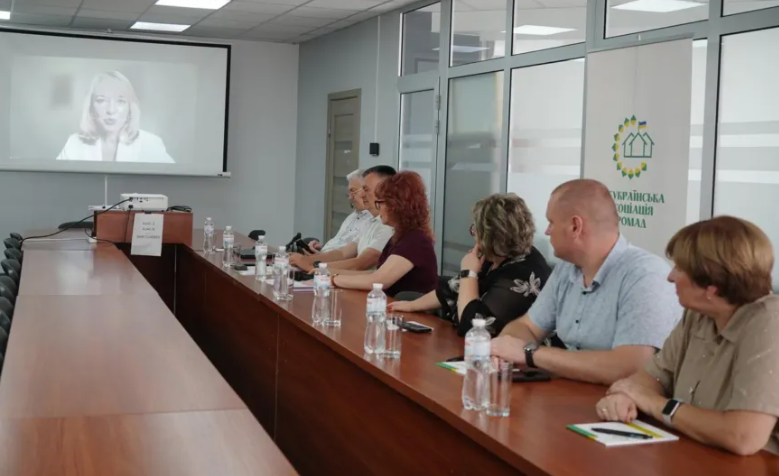

Photo: All-Ukrainian Association of Hromadas
Representatives of the All-Ukrainian Association of Hromadas also presented arguments in favour of the changes. Savelii Uzhva-Skliar, Head of the Association’s Expert Platform, described allocating PIT revenue based on an employee’s place of residence as the most socially equitable and people-centred option.
“If reduced to a single word, this is a class issue. It is understandable that wealthier hromadas hosting large businesses will oppose the redistribution of PIT revenue, while the hromadas whose residents sustain those businesses will support it. However, I believe that allocating PIT revenue based on an employee’s place of residence is the most socially equitable and people-centred approach,” said Savelii Uzhva-Skliar.
According to the findings of a survey on hromadas’ legislative priorities, published by the Decentralisation portal on 1 September 2026, 63% of the surveyed local self-government leaders identified increasing the share of PIT revenue allocated to local budgets as a priority. Meanwhile, 57% prioritised changes that would allocate PIT revenue based on taxpayers’ place of residence or distribute it between their place of employment and residence.
More information about the possible models, their benefits and risks is available in the analysis and roadmap prepared by Polaris Programme experts.
Photo: All-Ukrainian Association of Hromadas

