
Author: Ihor Onyshchuk, an expert on local budgets with the Polaris programme ‘Supporting Multilevel Governance in Ukraine’
The year 2025 proved to be yet another challenge for Ukraine’s budgetary system. Against the backdrop of the ongoing war, the main focus of state policy was on defence capabilities, which inevitably affected the reallocation of resources. However, despite the withdrawal of the ‘military’ personal income tax and other restrictions, local budgets demonstrated unexpected resilience. Thanks to effective local management, support from international partners and business adaptation, most hromadas were able to ensure the fulfilment of critical expenditure and support for the functioning of frontline and rear areas.
Thus, despite four years of full-scale war, the local finance system continues to demonstrate resilience and the ability to ensure the delivery of hromadas’ core functions. The implementation of local budgets in 2025 took place against a backdrop of significant pressure on public finances, rising defence expenditure and the centralisation of resources. At the same time, the hromadas have maintained stable revenues and the ability to fund key services, demonstrating the adaptability of local self-government to the conditions of a war economy. An analysis of local budget implementation for 2025 allows for an assessment of hromadas’ actual financial capabilities, their role within the public finance system, and the main trends in the shift of the budgetary balance between the state and local levels.
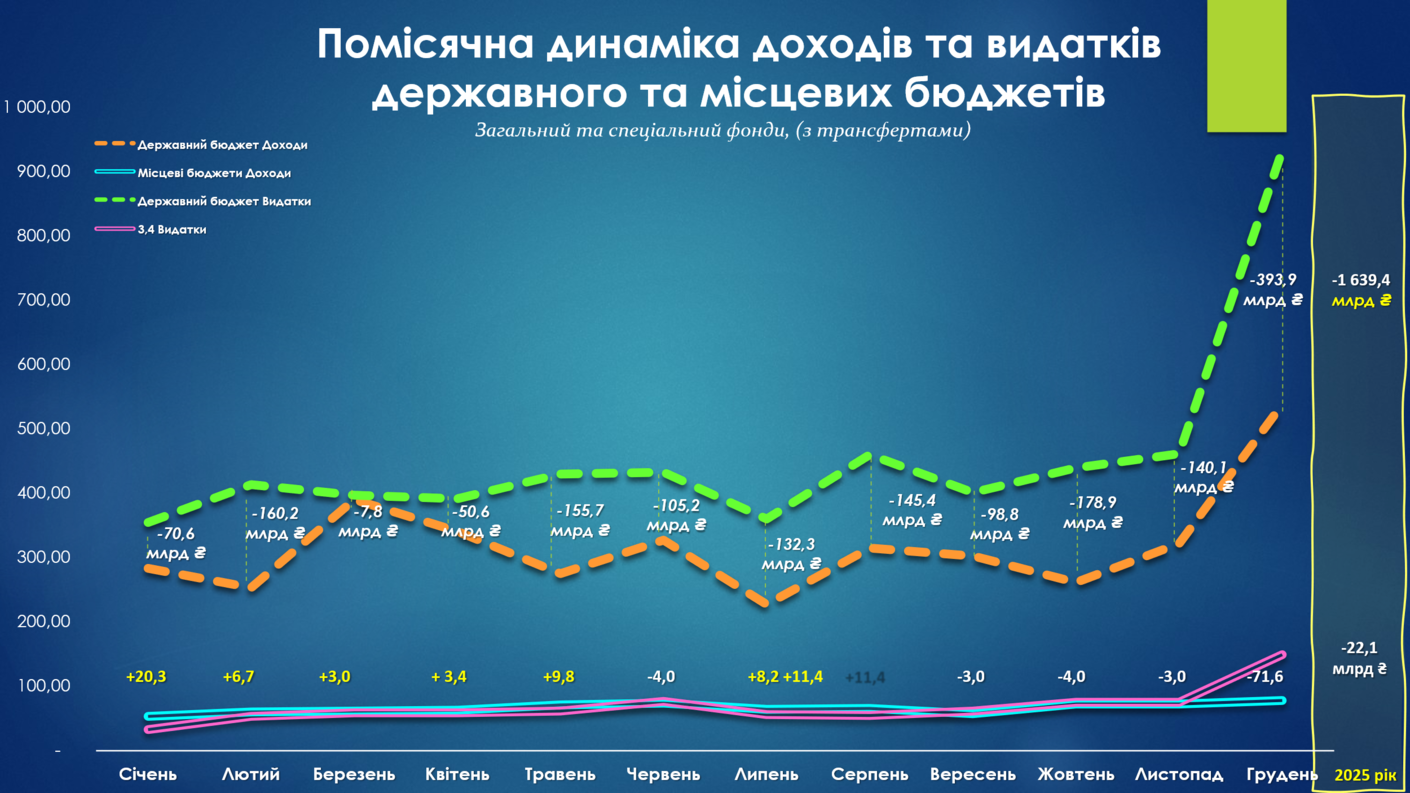
Of particular interest is the month-on-month trend, which reflected the actual state of economic activity in hromadas. During the first half of 2025, local budgets were predominantly accumulating resources, as evidenced by a positive balance in most months. January proved to be the most surplus-rich, with a surplus of +20.3 billion UAH, as did August, with a figure of +11.4 billion UAH. Such periodic ‘surpluses’ allowed hromadas to build up the necessary reserves. The graph clearly shows that hromadas’ revenues and expenditures moved almost in parallel, without the sharp fluctuations that were characteristic of the national level. This indicated that hromadas had learned to promptly adjust their spending plans in line with actual revenues, despite the withdrawal of a portion of tax resources.
However, the end of 2025 brought about significant changes to the overall statistics. As is traditional in Ukrainian budgetary practice, the peak of the financial burden fell in December. The graph shows a sharp rise in expenditure, which led to a monthly deficit at local level of -71.6 billion UAH. This surge occurred against the backdrop of an even larger state budget deficit, which reached a record -393.9 billion UAH in December. It is important to emphasise that it was this December shortfall that effectively determined the final annual deficit of local budgets, as the system had been largely self-sufficient in previous months.
Overall, the results for 2025 confirmed that local government had withstood the trials of war and resource constraints. Whilst the state budget operated with a maximum deficit in the interests of victory, hromadas were able to maintain a balance. The final figure of -22.1 billion UAH for all local budgets across the country demonstrates that decentralisation has created a sufficient margin of safety, enabling the system not only to survive but also to manage resources effectively amid the highest levels of uncertainty.

