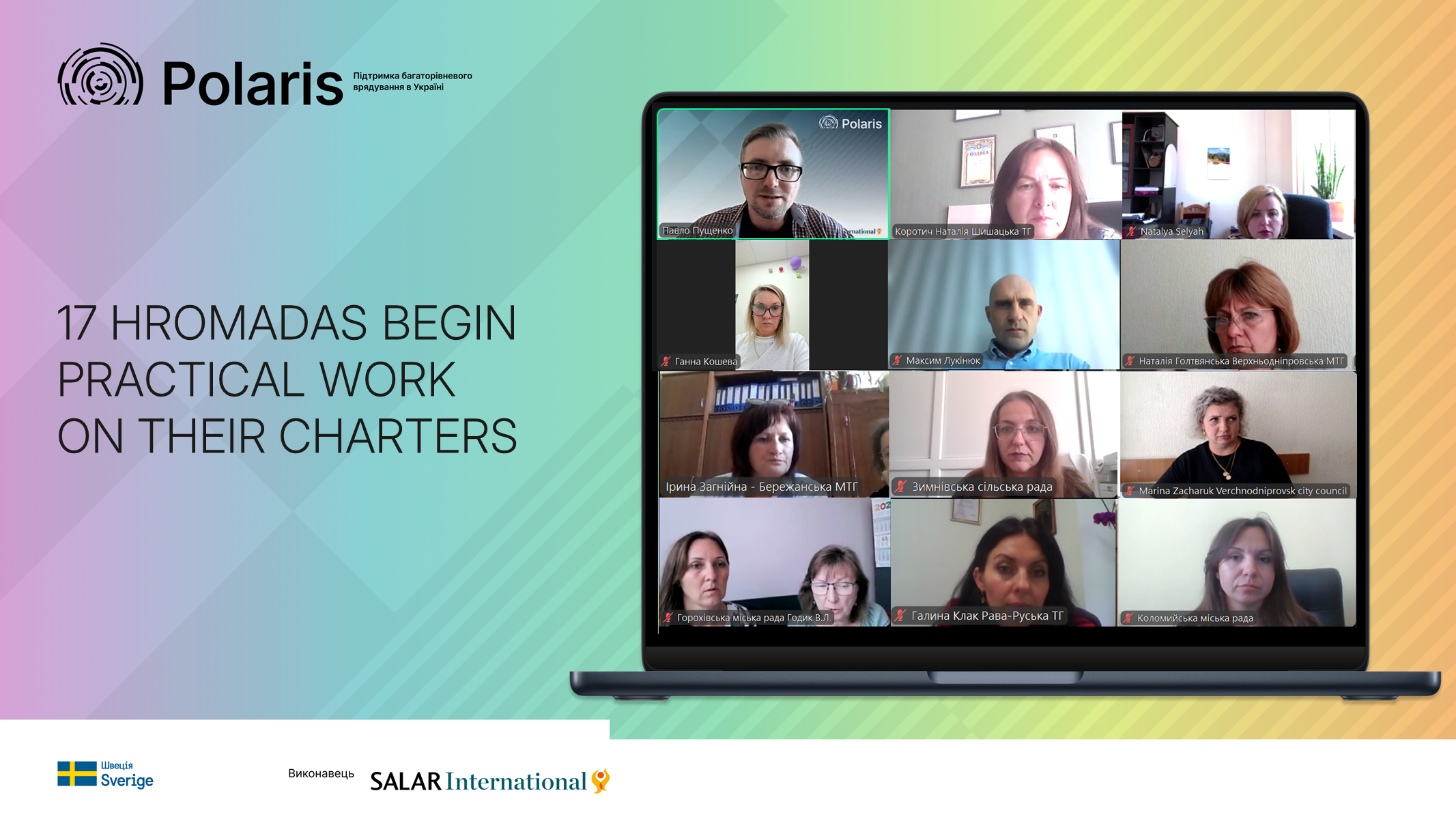
The Polaris Programme has launched the practical phase of support for partner hromadas in developing draft Territorial Hromada Charters. The work is being carried out in the “Local Engagement” area and includes expert support at every stage — from drafting the document to public consultation and implementation.
On 9 September, representatives of 17 hromadas selected by the Programme to participate in this area joined an online working session. The discussion focused on organising the work of the working groups, drafting specific provisions and communicating with residents.
Participants explored how to establish a working group and organise its activities, engage representatives of civil society and businesses, assign responsibilities, and plan the key stages of drafting the document. Particular attention was given to ensuring an open process and incorporating residents’ proposals.
The hromadas have already received a roadmap for drafting their Charters, a list of provisions to be developed, and tools for tracking progress. The working groups are currently gathering information about the historical, cultural, socio-economic and other characteristics of their territories. They are also identifying additional forms of resident participation in addressing matters of local importance.
“The greatest challenge in this process is not simply drafting a legally sound document, but agreeing on rules that will genuinely work in a particular hromada. That is why we combine methodological support with individual consultations while leaving room for solutions that reflect the local context,” said Pavlo Pushchenko, an expert of the Polaris Programme.
Another part of the session focused on communication support. Hromada representatives worked on identifying target audiences, developing clear messages, selecting communication channels, and evaluating the effectiveness of information campaigns. Particular emphasis was placed on explaining to residents not only what a Hromada Charter is, but also what opportunities it provides for participating in decisions on local matters.
“The value of such meetings is that they make a large and complex process clear and structured. We can see where to begin, at which stages it is important to engage residents, and where more time should be allowed for discussing and agreeing on decisions,” said Nataliia Seliakh, Administrative Manager (Secretary) of the Executive Committee of Berezne City Council, Rivne Oblast.
The next stage will involve individual expert consultations from September to November. A webinar on conducting public consultations on draft Hromada Charters and submitting them for a vote is scheduled for October. In December, participants will review the results, challenges and next steps during an in-person meeting in Lviv.
By the end of 2026, all territorial hromadas in Ukraine must adopt Hromada Charters or bring their existing documents into compliance with legislative requirements. For the Polaris partner hromadas, this process has already moved into practical implementation.